
Implementing AI Document Processing for Nepali Banks and Cooperatives
Real-world AI use case: automating loan application processing for a Nepali cooperative citizenship cards, salary slips, and bank statements.
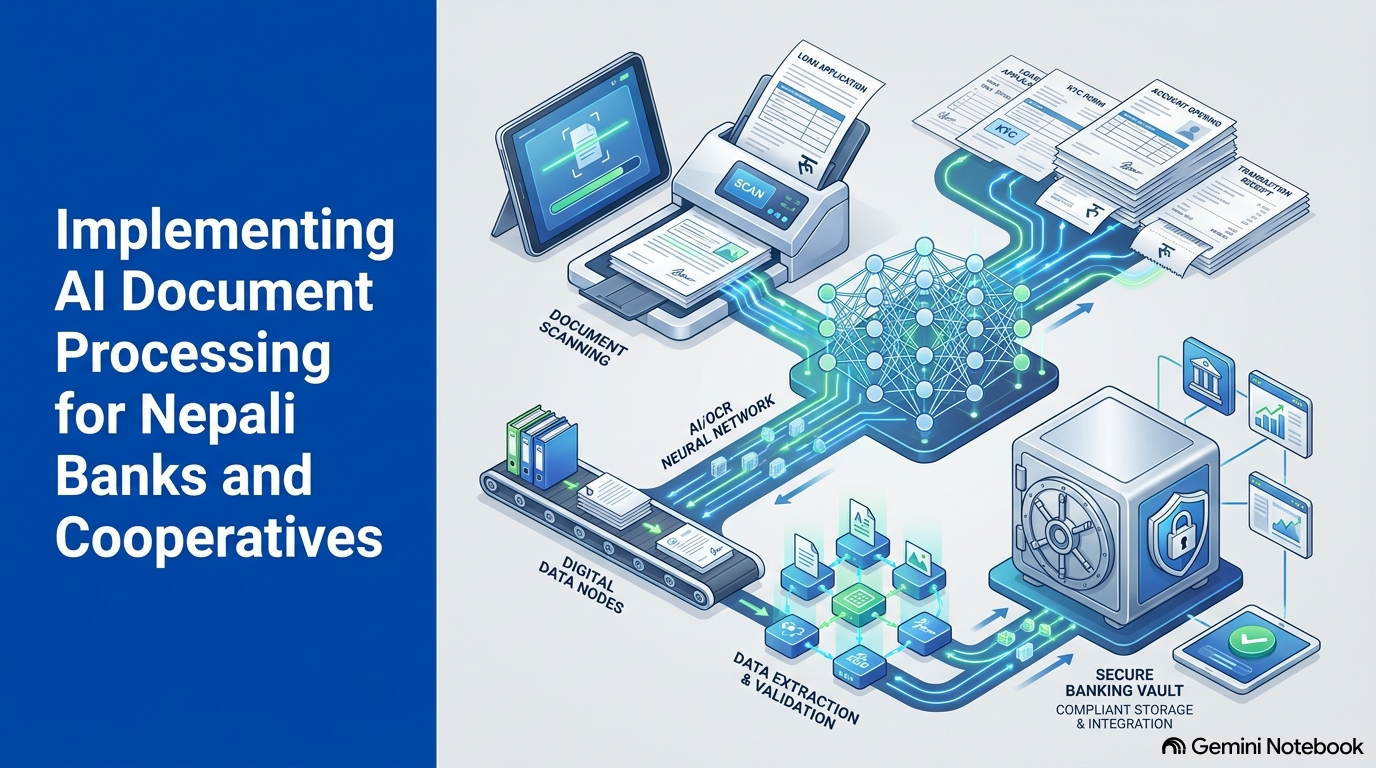
Banks and cooperatives across Nepal process thousands of documents weekly citizenship cards, salary slips, land documents, bank statements. Most of this is still done manually. AI changes the economics dramatically.
The Old Workflow
A loan officer receives a physical or scanned application. They manually verify each document, copy data into the core banking system, cross-check with the credit information bureau, and prepare an assessment. This takes hours per application.
The AI-Augmented Workflow
Documents are scanned and routed to an OCR pipeline trained specifically on Devanagari text. Key fields name, citizenship number, salary, employer are extracted automatically. The system flags anomalies and prepares a draft assessment. The officer reviews and approves in minutes.
Technology Choices
We combine specialized Devanagari OCR (we fine-tune open models on Nepali documents) with structured extraction using LLMs. Sensitive processing stays on-premise; only the necessary classification happens via API.
Real Impact
For one cooperative engagement, application processing time dropped from 3 days to 4 hours. Loan officer capacity tripled without adding headcount. False acceptance rates dropped because the model catches inconsistencies humans miss when fatigued.
Compliance Notes
NRB compliance and customer data protection are non-negotiable. We architect these systems with full audit logs, role-based access, and on-premise inference for sensitive workloads.